


















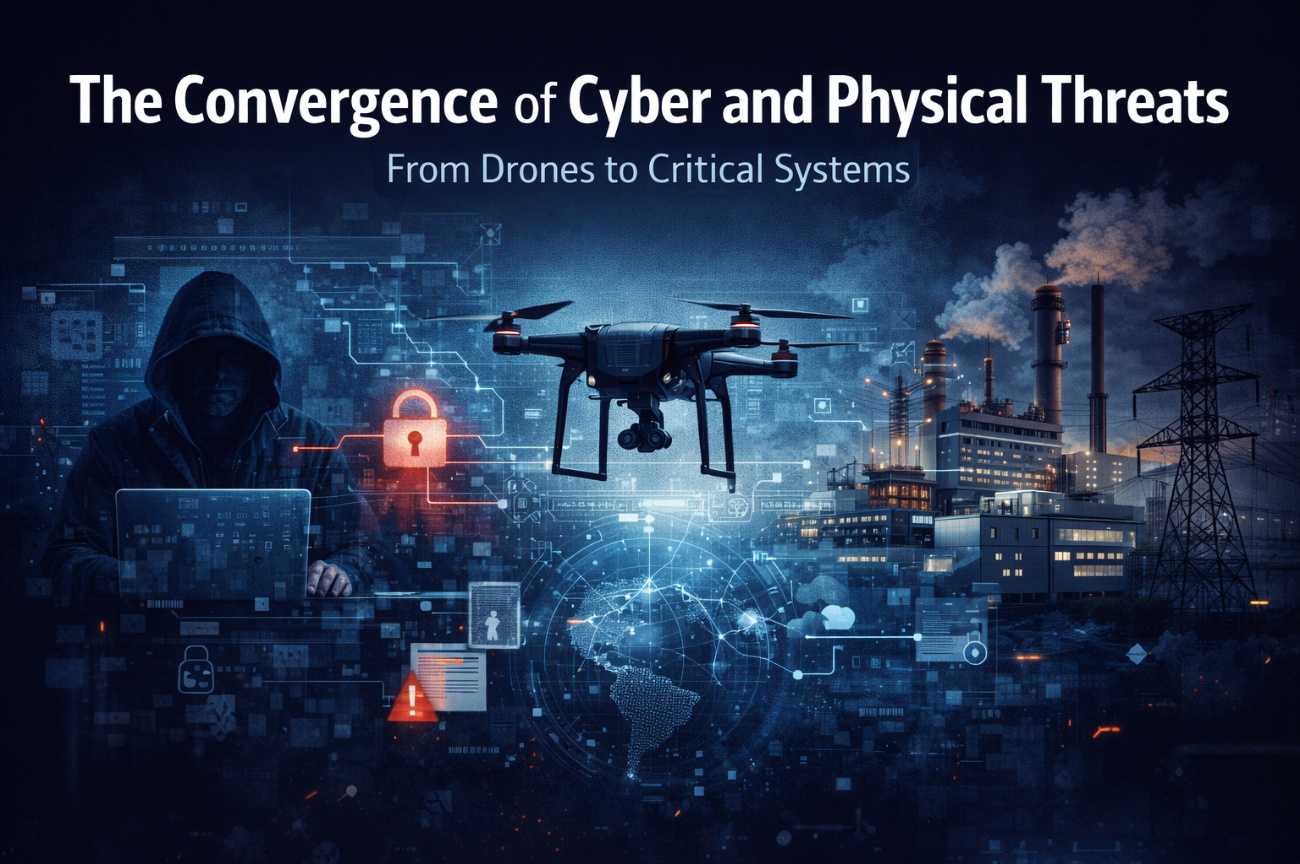
The modern threat landscape is undergoing a fundamental transformation. Cybersecurity is no longer confined to digital assets, networks, or data alone — it increasingly intersects with the physical world. From autonomous drones and smart infrastructure to industrial control systems and connected transportation, attackers now exploit both cyber and physical vectors in coordinated campaigns.
This evolution has given rise to cyber-physical threats, where digital intrusions can trigger real-world consequences, and physical attacks can be enhanced through cyber capabilities. Governments and security frameworks globally are recognizing this convergence as a critical risk affecting national security, critical infrastructure resilience, and public safety.
Understanding Cyber-Physical Threat Convergence
Cyber-physical convergence refers to the integration of digital systems with physical processes through sensors, connectivity, and automation. While this integration enhances efficiency and operational intelligence, it also expands the attack surface.
Examples of cyber-physical environments include:
- Smart cities and intelligent transportation systems
- Industrial control systems (ICS) and SCADA networks
- Autonomous drones and robotics
- Healthcare devices and medical IoT
- Energy grids and smart utilities
In such ecosystems, a successful cyber intrusion can disrupt physical operations, damage infrastructure, or threaten human safety.
The Rise of Hybrid Threat Actors
Threat actors are increasingly adopting hybrid strategies that combine cyber attacks, physical sabotage, and information operations. Nation-state groups, organized cybercriminals, and terrorist organizations are leveraging this convergence to achieve strategic objectives with minimal direct confrontation.
Hybrid threat campaigns may involve:
- Cyber attacks disrupting operational technology (OT) environments
- Physical reconnaissance supported by cyber intelligence gathering
- Drone-enabled surveillance combined with network exploitation
- Information warfare amplifying the psychological impact of physical incidents
This blended approach complicates detection and response, as security teams must monitor both digital signals and physical indicators simultaneously.
Drones as a New Cyber-Ph ysical Attack Vector
Unmanned Aerial Vehicles (UAVs), commonly known as drones, have emerged as powerful tools across commercial, military, and consumer domains. However, their connectivity, autonomy, and accessibility also make them attractive targets and tools for malicious actors.
Cyber Exploitation of Drones
Attackers may exploit vulnerabilities in drone firmware, communication protocols, or control systems to hijack operations, intercept data, or disrupt missions.
Potential risks include:
- Unauthorized drone takeover
- GPS spoofing and navigation manipulation
- Data interception from onboard sensors and cameras
- Malicious firmware injection
Drones as Offensive Tools
Beyond being targets, drones can also be weaponized to support cyber-physical attacks by enabling reconnaissance, delivering payloads, or disrupting operations in restricted environments.
Critical Infrastructure at the Intersection of Cyber and Physical Risk
Critical infrastructure sectors — including energy, transportation, healthcare, water, and telecommunications — rely heavily on interconnected cyber-physical systems. These environments often operate legacy OT systems integrated with modern IT networks, creating complex security challenges.
Energy and Utilities
Attacks on power grids can disrupt electricity supply, affecting essential services and economic stability. Compromised grid control systems can trigger cascading failures across regions.
Transportation and Smart Mobility
Connected vehicles, rail networks, and traffic management systems are vulnerable to cyber manipulation, potentially leading to operational disruptions or safety hazards.
Healthcare Systems
Medical devices, hospital automation systems, and connected diagnostics introduce risks where cyber attacks may directly impact patient safety and service availability.
Industrial and Manufacturing Environments
Manufacturing plants leveraging automation and robotics face risks from cyber intrusions that can halt production lines or cause equipment malfunction.
Emerging Threat Scenarios
1. Cyber-Enabled Physical Sabotage
Attackers infiltrate control systems to manipulate physical processes, causing equipment failure or operational disruption.
2. Coordinated Drone and Cyber Attacks
Drones may be used for reconnaissance while cyber attacks simultaneously target infrastructure control systems.
3. Supply Chain Compromise Affecting Physical Operations
Compromised software or hardware components can introduce vulnerabilities into industrial environments, enabling long-term exploitation.
4. Smart City Exploitation
Manipulating connected urban systems such as traffic lights, surveillance networks, or public services can create widespread disruption.
Challenges in Securing Cyber-Physical Systems
1. Legacy Infrastructure
Many OT environments were not designed with cybersecurity in mind, making them vulnerable to modern attack techniques.
2. Limited Visibility Across IT and OT Domains
Traditional IT security tools often lack visibility into industrial protocols and physical processes.
3. Complex Attack Detection
Cyber-physical attacks may not exhibit typical digital indicators, requiring integrated monitoring across digital and operational environments.
4. Skill and Coordination Gaps
Securing cyber-physical environments requires collaboration between cybersecurity teams, engineers, and operational staff — a challenge for many organizations.
Strategic Approaches to Mitigation
1. Converged IT-OT Security Frameworks
Organizations must adopt integrated security models that bridge IT and operational technology, enabling unified visibility and response.
2. Zero Trust for Cyber-Physical Systems
Implementing identity-centric access controls and continuous verification helps limit lateral movement across interconnected environments.
3. Drone Security and Airspace Monitoring
Organizations operating drones should implement encryption, secure communication protocols, and anomaly detection mechanisms to prevent unauthorized control.
4. Continuous Monitoring and Anomaly Detection
Behavioral analytics and AI-driven monitoring can help identify unusual operational patterns indicative of cyber-physical compromise.
5. Resilience and Incident Response Planning
Preparedness strategies should include cross-domain incident response exercises simulating cyber-physical attack scenarios.
The Role of Emerging Technologies in Defense
Advanced technologies are playing a critical role in defending against converged threats:
- AI-driven threat detection across cyber and physical telemetry
- Digital twins for simulating infrastructure resilience
- Autonomous security drones for surveillance and monitoring
- Blockchain for secure device identity and supply chain integrity
- Post-quantum cryptography protecting critical communications
These innovations support proactive defense strategies capable of addressing evolving hybrid threats.
Future Outlook: A Security Paradigm Shift
The convergence of cyber and physical threats represents a shift from isolated security domains toward integrated resilience strategies. As smart infrastructure, automation, and connected devices continue to proliferate, the boundaries between cyber and physical security will further dissolve.
Organizations and governments must therefore prioritize:
- Cross-domain risk assessments
- Collaborative security governance
- Investment in cyber-physical threat intelligence
- Workforce development bridging engineering and cybersecurity skills
- Adoption of adaptive and resilient security architectures
Conclusion
Cyber-physical threat convergence highlights the evolving nature of modern security challenges, where digital intrusions can produce tangible physical consequences. From drone exploitation to infrastructure disruption, attackers are leveraging interconnected systems to amplify impact and complexity.
Addressing this risk requires a holistic security approach that integrates cybersecurity, physical security, operational resilience, and strategic governance. As societies continue to rely on intelligent infrastructure and autonomous technologies, the ability to secure cyber-physical ecosystems will become a defining factor in ensuring national security, economic stability, and public safety.