
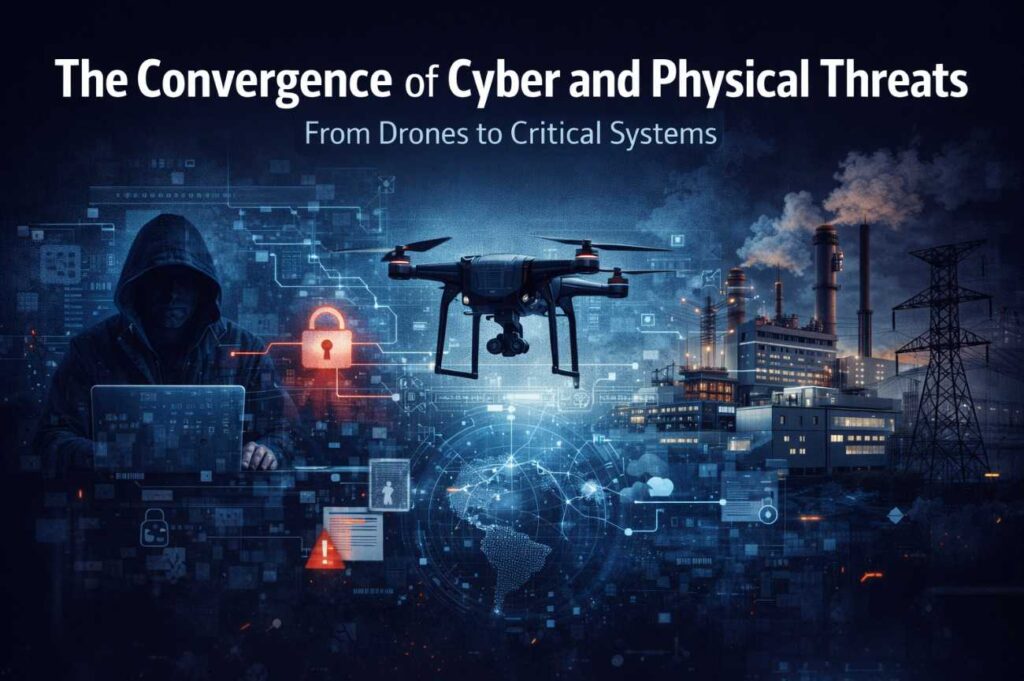
Cyber-Physical Threats: Drones to Critical Systems

The modern threat landscape is undergoing a fundamental transformation. Cybersecurity is no longer confined to digital assets, networks, or data alone — it increasingly intersects with the physical world. From autonomous drones and smart infrastructure to industrial control systems and connected transportation, attackers now exploit both cyber and physical vectors in coordinated campaigns.
This evolution has given rise to cyber-physical threats, where digital intrusions can trigger real-world consequences, and physical attacks can be enhanced through cyber capabilities. Governments and security frameworks globally are recognizing this convergence as a critical risk affecting national security, critical infrastructure resilience, and public safety.

Understanding Cyber-Physical Threat Convergence

Cyber-physical convergence refers to the integration of digital systems with physical processes through sensors, connectivity, and automation. While this integration enhances efficiency and operational intelligence, it also expands the attack surface.
Examples of cyber-physical environments include:

In such ecosystems, a successful cyber intrusion can disrupt physical operations, damage infrastructure, or threaten human safety.

Defensive Strategies Against Information Warfare

Emerging Threat Scenarios

1. Cyber-Enabled Physical Sabotage

Attackers infiltrate control systems to manipulate physical processes, causing equipment failure or operational disruption.

2. Coordinated Drone and Cyber Attacks

Drones may be used for reconnaissance while cyber attacks simultaneously target infrastructure control systems.

3. Supply Chain Compromise Affecting Physical Operations

Compromised software or hardware components can introduce vulnerabilities into industrial environments, enabling long-term exploitation.

4. Smart City Exploitation

Manipulating connected urban systems such as traffic lights, surveillance networks, or public services can create widespread disruption.

Challenges in Securing Cyber-Physical Systems
1. Legacy Infrastructure

Many OT environments were not designed with cybersecurity in mind, making them vulnerable to modern attack techniques.

2. Limited Visibility Across IT and OT Domains

Traditional IT security tools often lack visibility into industrial protocols and physical processes.

3. Complex Attack Detection

Cyber-physical attacks may not exhibit typical digital indicators, requiring integrated monitoring across digital and operational environments.

4. Skill and Coordination Gaps

Securing cyber-physical environments requires collaboration between cybersecurity teams, engineers, and operational staff — a challenge for many organizations.

Strategic Approaches to Mitigation

1. Converged IT-OT Security Frameworks

Organizations must adopt integrated security models that bridge IT and operational technology, enabling unified visibility and response.

2. Zero Trust for Cyber-Physical Systems

Implementing identity-centric access controls and continuous verification helps limit lateral movement across interconnected environments.

3. Drone Security and Airspace Monitoring

Organizations operating drones should implement encryption, secure communication protocols, and anomaly detection mechanisms to prevent unauthorized control.

4. Continuous Monitoring and Anomaly Detection

Behavioral analytics and AI-driven monitoring can help identify unusual operational patterns indicative of cyber-physical compromise.

5. Resilience and Incident Response Planning

Preparedness strategies should include cross-domain incident response exercises simulating cyber-physical attack scenarios.


Future Outlook: A Security Paradigm Shift

The convergence of cyber and physical threats represents a shift from isolated security domains toward integrated resilience strategies. As smart infrastructure, automation, and connected devices continue to proliferate, the boundaries between cyber and physical security will further dissolve.

Organizations and governments must therefore prioritize:

Conclusion

Cyber-physical threat convergence shows how cyber attacks can now create real-world consequences across critical infrastructure and connected systems. As technologies like drones, smart infrastructure, and automation expand, securing both digital and physical environments becomes essential.
CyberTech Infosolutions helps organizations strengthen cyber-physical security through expert assessments and advanced protection strategies. Connect with CyberTech Infosolutions to secure your critical systems and build a more resilient infrastructure.

Trusted Cybersecurity Services. World Class Training. Real world Impact