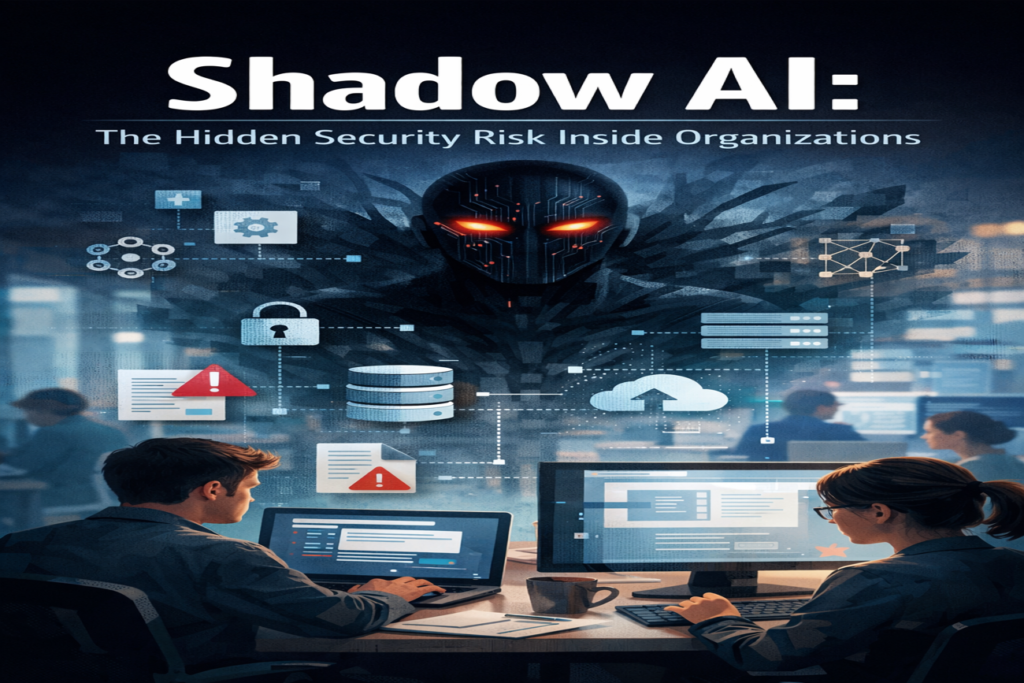
Shadow AI: Hidden Enterprise Risk

The accelerated adoption of Artificial Intelligence across business functions has reshaped how organizations operate, innovate, and compete. Employees are increasingly leveraging generative AI platforms, automation tools, and intelligent assistants to enhance productivity, streamline workflows, and improve decision-making.

Shadow AI refers to the unsanctioned use of artificial intelligence tools, models, or services by employees without formal approval, oversight, or integration into organizational governance frameworks. While these tools may provide immediate operational benefits, their uncontrolled use can expose organizations to data leakage, compliance violations, intellectual property risks, and expanded cyber attack surfaces.

As enterprises continue their digital transformation journeys, Shadow AI has emerged as a critical intersection of cybersecurity, governance, privacy, and organizational culture.

Understanding Shadow AI in the Enterprise Context

Shadow AI is conceptually derived from the notion of Shadow IT but carries additional complexity due to the nature of AI systems. Unlike traditional unauthorized software, AI tools interact with data dynamically, learn from inputs, and may store or process sensitive information in ways that are not fully transparent to users.

Common Shadow AI scenarios include:

Common Shadow AI scenarios include:

These practices often occur with positive intent — employees seeking efficiency or innovation — but they inadvertently introduce risks that traditional security controls may not detect.

Drivers Behind the Rise of Shadow AI

Several organizational and technological factors are contributing to the rapid growth of Shadow AI adoption.

1. Democratization of AI Tools

AI services are widely accessible, requiring minimal technical expertise and offering immediate value. Employees can integrate AI into workflows without infrastructure changes or IT involvement.

2. Productivity and Competitive Pressure

Teams operating under tight deadlines or performance expectations often turn to AI to automate repetitive tasks, generate insights, or accelerate development cycles.

3. Absence of Formal AI Governance

Many organizations are still in early stages of defining AI policies, resulting in uncertainty regarding acceptable usage, data sharing boundaries, and tool approval processes.

4. Innovation-Oriented Work Cultures

Organizations encouraging experimentation and digital innovation may inadvertently create environments where employees independently explore AI solutions without structured oversight.

Collectively, these factors contribute to an imbalance where AI adoption progresses faster than risk management and governance capabilities.

Shadow AI as an Insider Risk Vector

Shadow AI intersects closely with insider threat dynamics. Unlike malicious insider activity, Shadow AI incidents typically involve well-intentioned employees unaware of associated risks. However, the impact can be equally severe.

Examples include:

These scenarios highlight the importance of addressing Shadow AI through both technical controls and behavioral awareness initiatives.

Strategic Approaches to Mitigating Shadow AI Risks

1. Establish Comprehensive AI Usage Policies

Organizations should define clear guidelines outlining acceptable AI usage, data handling practices, and approval processes. Policies should balance security requirements with innovation objectives.

2. Implement Enterprise AI Governance Frameworks

Formal governance structures enable risk assessments, tool evaluation, and lifecycle management for AI deployments. Collaboration between security, legal, compliance, and business units is essential.

3. Enhance Visibility Through Security Tooling

Technologies such as Cloud Access Security Brokers (CASB), SaaS discovery platforms, and network monitoring solutions can help identify unauthorized AI usage and track data flows.

4. Promote Security Awareness and Responsible AI Adoption

Employee education programs should address the risks associated with AI interactions, emphasizing safe data sharing practices and policy compliance.

5. Provide Secure Enterprise AI Alternatives

Offering approved AI platforms with built-in privacy controls, logging, and governance reduces the likelihood of employees seeking external solutions.

6. Integrate Shadow AI into Risk Management Programs

Shadow AI should be incorporated into threat modeling, vulnerability assessments, and incident response planning to ensure comprehensive security coverage.


The Future Outlook: Managing Innovation Without Sacrificing Security

As AI capabilities continue to evolve, Shadow AI risks will likely intensify. The emergence of autonomous AI agents, embedded AI features within SaaS platforms, and low-code AI automation tools will further complicate visibility and governance.

Forward-looking organizations are expected to adopt:

Conclusion

Shadow AI presents a growing challenge as AI tools become widely adopted without proper governance or security oversight. While these tools enhance productivity, uncontrolled usage can introduce risks related to data privacy, compliance, and organizational security.

CyberTech Infosolutions helps organizations manage these risks through AI governance frameworks, security assessments, and responsible AI adoption strategies. Connect with CyberTech Infosolutions to secure your enterprise in the age of AI.

Trusted Cybersecurity Services. World Class Training. Real world Impact